Artificial Intelligence (AI) Policy
Authorship Criteria and Author Contributions
Disclaimer and Publication Policy
Handling Allegations of Research Misconduct
Post-Publication Discussion and Corrections
Publication Ethics and Malpractice Statement


Editorial Note
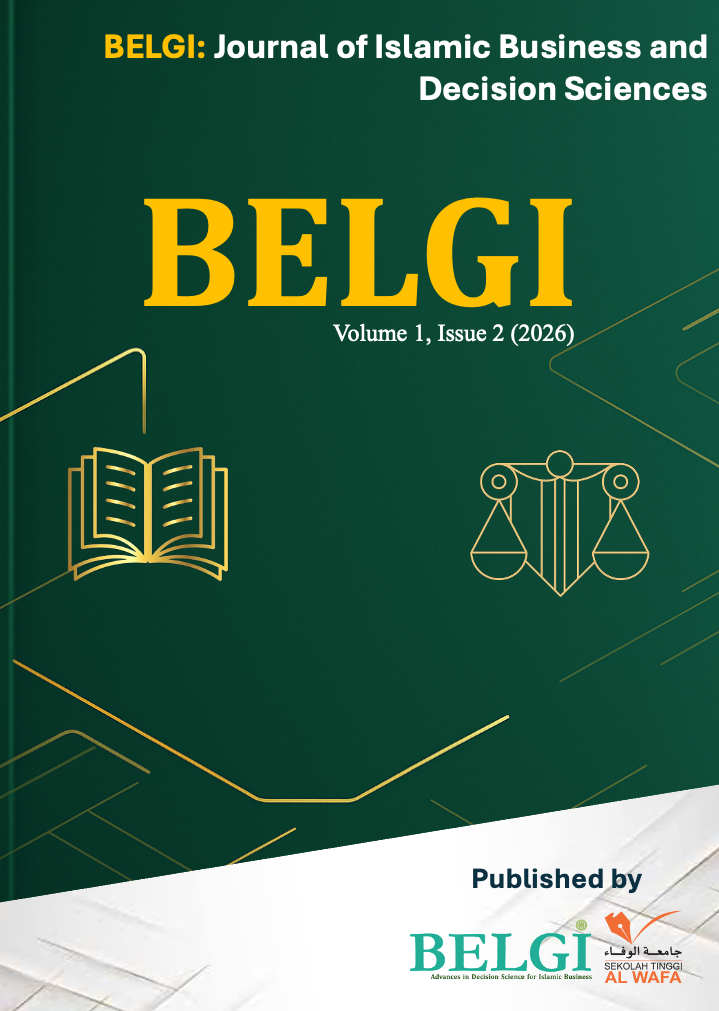
It is with great pleasure that we present the second issue of BELGI: Journal of Islamic Business and Decision Sciences (Vol. 1, No. 2, 2026), published in july 2026. Building on the strong foundation laid in our inaugural issue, this edition marks a continued commitment to scholarly excellence, methodological rigor, and contextual relevance in the study of Islamic business, consumer psychology, and ethically grounded decision making in digital and pluralistic environments.
To improve article-template completeness and align the journal's presentation with international publishing standards, the articles in this issue were updated using the revised template and republished on September 9, 2026. These updates concern article formatting and presentation and do not indicate changes to the published research findings.
This volume features six timely and theoretically rich research articles that collectively deepen our understanding of how religiosity, trust, risk perception, cognitive appraisal, and digital persuasion intersect in contemporary Muslim and pluralistic markets. The articles span diverse yet thematically cohesive topics, including:
One of the distinguishing strengths of this issue lies in its strong theoretical integration and methodological pluralism. Articles advance and test integrative frameworks, such as Stimulus Organism Response (SOR), Information Adoption Model (IAM), Trust Commitment Theory, Cognitive Appraisal Theory, and Signaling and Uncertainty Reduction Theories, while employing robust quantitative methods including PLS SEM, regression, and mediation analysis. Notably, several studies contextualize their models in under researched yet strategically significant settings, including Muslim minority communities in the Philippines, rural welfare recipients in Indonesia, and AI mediated fintech users, thereby enriching the global discourse on Islamic consumer behavior beyond dominant Muslim majority contexts.
As a biannual journal, BELGI remains steadfast in its mission to serve as a scholarly bridge between Islamic epistemology and modern decision sciences, fostering knowledge that is not only academically rigorous but also practically transformative for institutions, brands, policymakers, and communities navigating ethical complexity in digital economies.
We extend our deepest gratitude to the authors for their insightful contributions, and to our esteemed Section Editors and Reviewer Team for their exceptional dedication, rigorous critique, and constructive feedback, each instrumental in upholding the journal’s academic integrity and developmental ethos.
We also wish to thank Nobon Andra, S.T., for his continued technical stewardship of the BELGI OJS platform, and Shofiyya Zulfa, S.Pd.I, for her meticulous layout review and proofreading, ensuring this issue meets the highest standards of scholarly presentation.
May this issue inspire further critical inquiry, interdisciplinary collaboration, and ethically grounded innovation in Islamic business and decision sciences.
Dr. Ahmad Nuh, S.E., M.M. Dr. Tajuddin Pogo, M.H.
Editor-in-Chief Chairperson of STIS Al Wafa
Board of Editors
Reviewer Team


BELGI: Journal of Islamic Business and Decision Sciences.
Published by the Undergraduate Program in Shariah Economic Law, STIS Al Wafa, Indonesia,
Bengkel Roda Cipicung, Mekarsari, Kec. Cileungsi, Kabupaten Bogor, Jawa Barat, Indonesia, 16820.
E-mail : admin@belgifoods.com
E-ISSN 3123-769X
 This work is licensed under a Creative Commons Attribution 4.0 International License (CC BY 4.0) |