Disclaimer and Publication Policy


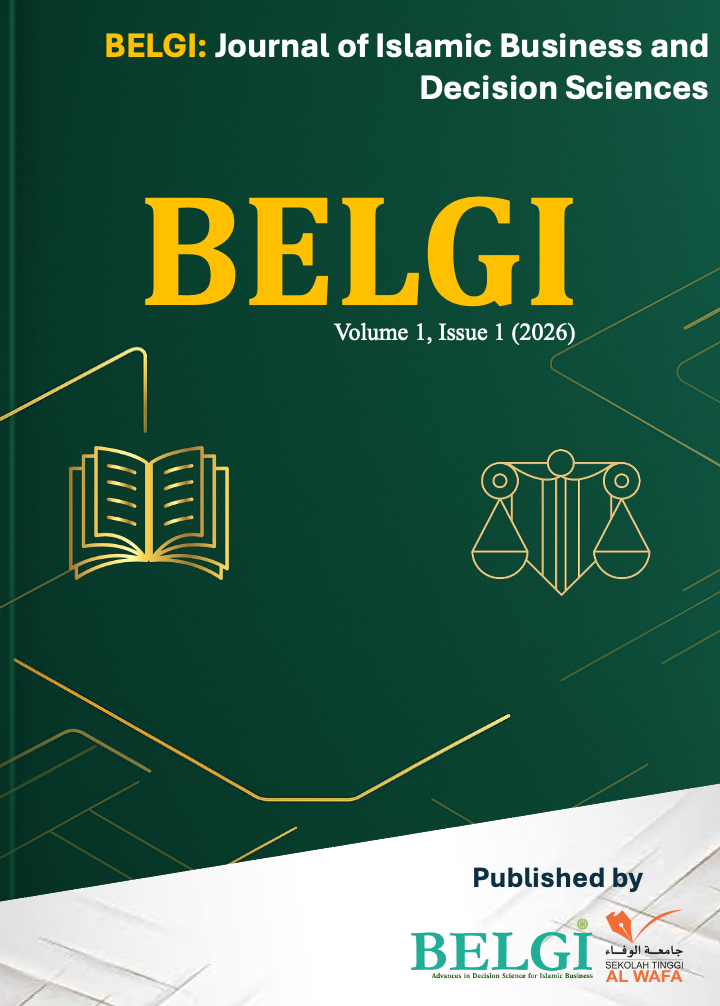
BELGI: Journal of Islamic Business and Decision Sciences is an international, peer-reviewed, open-access journal dedicated to publishing high-quality research at the intersection of decision science and Islamic business. The journal provides a scholarly platform for advancing knowledge, fostering academic dialogue, and supporting innovation in business practices shaped by Islamic values, with a particular emphasis on the food and service industries.
Editorial Note
It is with great pleasure that we present the inaugural volume of BELGI: Journal of Islamic Business and Decision Sciences (Vol. 1, No. 1, 2026). This first issue, released in January 2026, marks a significant milestone in our commitment to advancing interdisciplinary scholarship in Islamic business and decision sciences, anchored in rigorous research and contemporary relevance.
This volume features six pioneering research articles that collectively reflect the breadth and depth of inquiry in our field. The included studies explore critical topics such as informal consumer credit behavior in Indonesia, repurchase intention drivers for Muslim-made products, meta-analytic insights into Islamic religiosity and purchase intention, trust and commitment models in halal e-commerce, and the role of digital waqf in community sustainability using advanced expectation-confirmation technology modeling.
One of the key strengths of this issue is the diversity of methodological and theoretical approaches, spanning from meta-analytic techniques to trust and commitment modeling, as well as digital innovation frameworks for Islamic social finance. This diverse yet focused compendium provides valuable insights that not only deepen academic understanding but also offer pragmatic implications for practitioners and policymakers in the Islamic business domain.
As a biannual journal published every January and July under the Undergraduate Program in Shariah Economic Law at STIS Al Wafa, Indonesia, BELGI aims to foster knowledge dissemination, stimulate dialogue, and encourage collaboration among academics, industry leaders, and community stakeholders globally.
We anticipate that this edition will set a high standard for future issues and invite scholars to contribute their innovative research to sustain the dynamic discourse in Islamic business and related disciplines.
On behalf of the editorial team, we extend our deepest gratitude to the authors, reviewers, and readers for their invaluable contributions and support. The editorial team also acknowledges the valuable technical and editorial assistance provided by Nobon Andra, S.T., who managed the BELGI OJS website and IT system, and Shofiyya Zulfa, S.Pd.I, who conducted the final layout review and proofreading. Their contributions have been essential in ensuring the quality and smooth publication process of this inaugural issue.
Dr. Ahmad Nuh, S.E., M.M. Dr. Tajuddin Pogo, M.H.
Editor-in-Chief Chairperson of STIS Al Wafa
Board of Editors
1. Prof. Dr. Zohra Ghali.
- Saudi Electronic University, Saudi Arabia
2. Dr. Romy Estradha, S.T., M.Sc., M.T.
- Politeknik Statistika STIS, Jakarta, Indonesia
3. Assoc. Prof. Andi Muhammad Sadat, SE., M.Si., Ph.D.
- Universitas Negeri Jakarta, Indonesia
4. Dr. Abbas J Ali
- American-Arab Institute for Strategic Studies, United States.
5. Prof. Dr. Wasfi Asyur Abu Zayd.
- Mardin Artuklu University, Faculty of Islamic Sciences, Turkey
The editorial team would like to express its deepest gratitude to Prof. Dr. Zohra Ghali of Saudi Electronic University, Saudi Arabia and Prof. Dr. Abbas J. Ali of the American-Arab Institute for Strategic Studies, United States, for their invaluable prayers, encouragement, and steadfast support during the foundational stages of establishing BELGI: Journal of Islamic Business and Decision Sciences. Their guidance and scholarly insight have been instrumental in shaping the journal’s vision and upholding its academic integrity.
The team also extends its sincere appreciation to Rahma International Society, Kuwait, for its generous support in advancing research development in Indonesia through STIS Al Wafa, Indonesia. This partnership has played a vital role in creating a conducive environment for scholarly inquiry and academic excellence.
Finally, the editorial team gratefully acknowledges all members of the reviewer team for their rigorous, thoughtful, and timely contributions. Their expert feedback and constructive critiques have significantly enhanced the quality, methodological rigor, and scholarly value of this inaugural issue. This milestone would not have been possible without their unwavering commitment to advancing knowledge in the fields of Islamic business and decision sciences.
Reviewer Team
BELGI: Journal of Islamic Business and Decision Sciences is an international, peer-reviewed, open-access journal dedicated to publishing high-quality research at the intersection of decision science and Islamic business. The journal provides a scholarly platform for advancing knowledge, fostering academic dialogue, and supporting innovation in business practices shaped by Islamic values, with a particular emphasis on the food and service industries.
Editorial Note
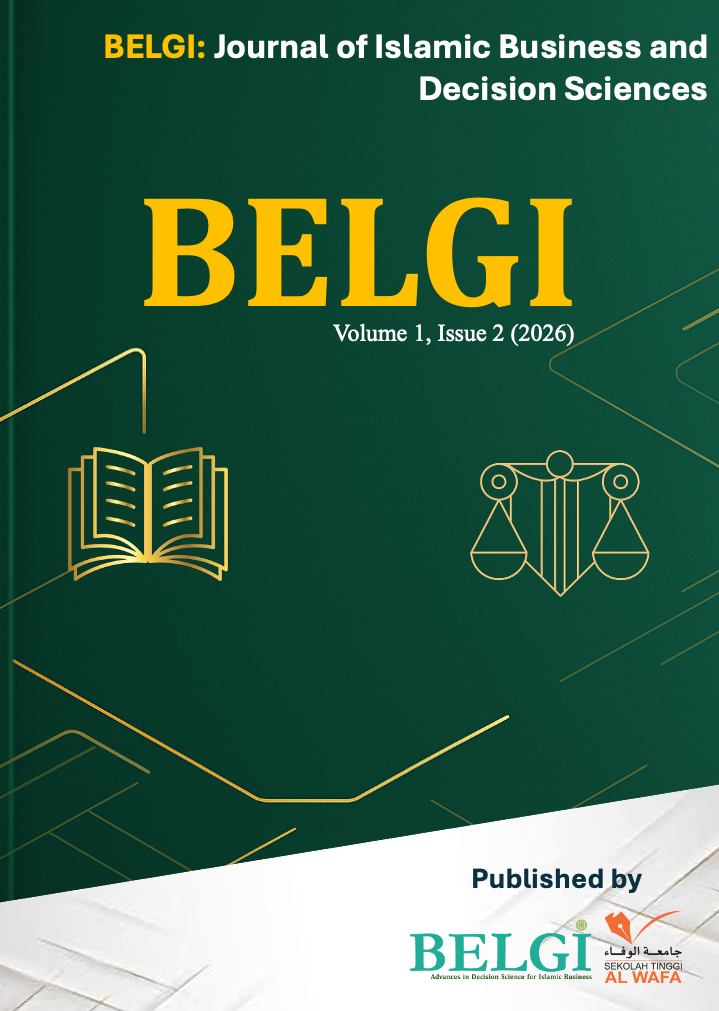
It is with great pleasure that we present the second issue of BELGI: Journal of Islamic Business and Decision Sciences (Vol. 1, No. 2, 2026), published in july 2026. Building on the strong foundation laid in our inaugural issue, this edition marks a continued commitment to scholarly excellence, methodological rigor, and contextual relevance in the study of Islamic business, consumer psychology, and ethically grounded decision making in digital and pluralistic environments.
This volume features six timely and theoretically rich research articles that collectively deepen our understanding of how religiosity, trust, risk perception, cognitive appraisal, and digital persuasion intersect in contemporary Muslim and pluralistic markets. The articles span diverse yet thematically cohesive topics, including:
One of the distinguishing strengths of this issue lies in its strong theoretical integration and methodological pluralism. Articles advance and test integrative frameworks, such as Stimulus Organism Response (SOR), Information Adoption Model (IAM), Trust Commitment Theory, Cognitive Appraisal Theory, and Signaling and Uncertainty Reduction Theories, while employing robust quantitative methods including PLS SEM, regression, and mediation analysis. Notably, several studies contextualize their models in under researched yet strategically significant settings, including Muslim minority communities in the Philippines, rural welfare recipients in Indonesia, and AI mediated fintech users, thereby enriching the global discourse on Islamic consumer behavior beyond dominant Muslim majority contexts.
As a biannual journal, BELGI remains steadfast in its mission to serve as a scholarly bridge between Islamic epistemology and modern decision sciences, fostering knowledge that is not only academically rigorous but also practically transformative for institutions, brands, policymakers, and communities navigating ethical complexity in digital economies.
We extend our deepest gratitude to the authors for their insightful contributions, and to our esteemed Section Editors and Reviewer Team for their exceptional dedication, rigorous critique, and constructive feedback, each instrumental in upholding the journal’s academic integrity and developmental ethos.
We also wish to thank Nobon Andra, S.T., for his continued technical stewardship of the BELGI OJS platform, and Shofiyya Zulfa, S.Pd.I, for her meticulous layout review and proofreading, ensuring this issue meets the highest standards of scholarly presentation.
May this issue inspire further critical inquiry, interdisciplinary collaboration, and ethically grounded innovation in Islamic business and decision sciences.
Dr. Ahmad Nuh, S.E., M.M. Dr. Tajuddin Pogo, M.H.
Editor-in-Chief Chairperson of STIS Al Wafa
Board of Editors
1. Prof. Dr. Zohra Ghali.
- Saudi Electronic University, Saudi Arabia
2. Dr. Romy Estradha, S.T., M.Sc., M.T.
- Politeknik Statistika STIS, Jakarta, Indonesia
3. Assoc. Prof. Andi Muhammad Sadat, SE., M.Si., Ph.D.
- Universitas Negeri Jakarta, Indonesia
4. Dr. Abbas J Ali
- American-Arab Institute for Strategic Studies, United States.
5. Prof. Dr. Wasfi Asyur Abu Zayd.
- Mardin Artuklu University, Faculty of Islamic Sciences, Turkey
Reviewer Team
BELGI: Journal of Islamic Business and Decision Sciences.
Published by the Undergraduate Program in Shariah Economic Law, STIS Al Wafa, Indonesia,
Bengkel Roda Cipicung, Mekarsari, Kec. Cileungsi, Kabupaten Bogor, Jawa Barat, Indonesia, 16820.
E-mail : admin@belgifoods.com
E-ISSN 3123-769X
 This work is licensed under a Creative Commons Attribution 4.0 International License (CC BY 4.0) |